
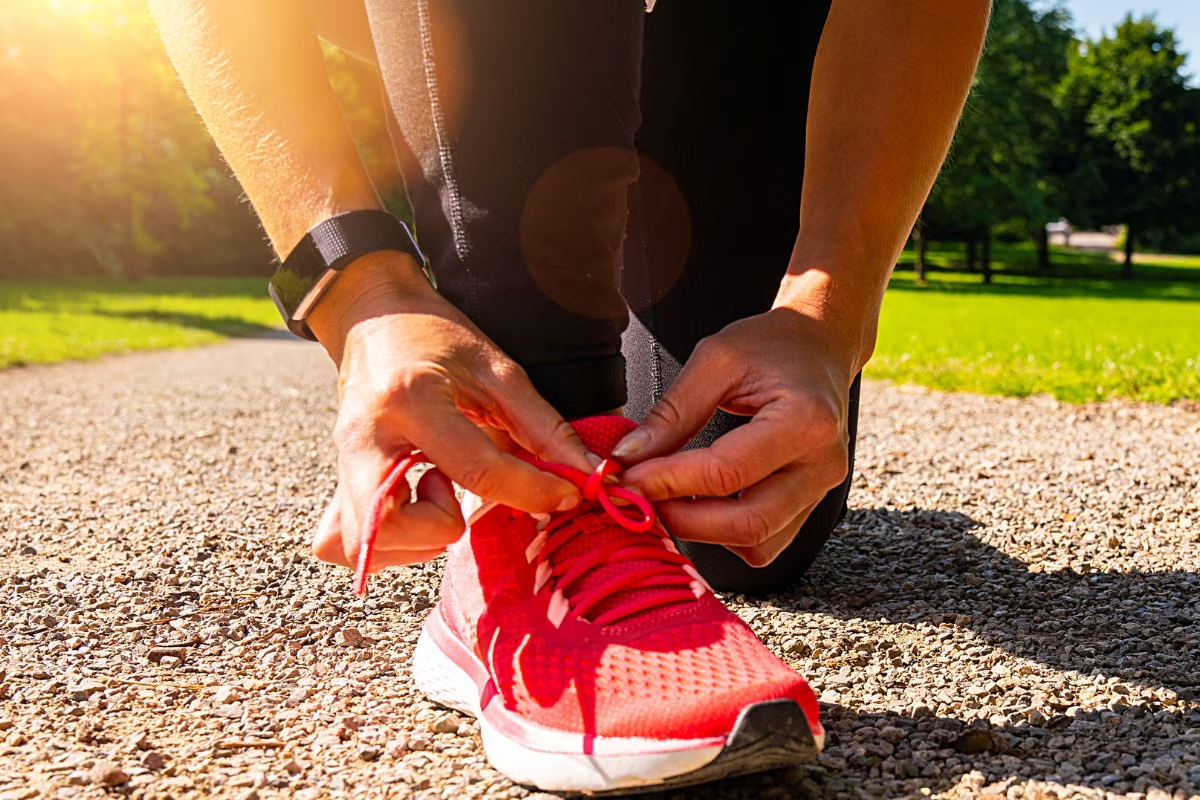
Once you hit your 40s, your feet tend to get a little more opinionated. The best running shoes for women over 40 aren’t always the ones that worked in your 20s. The shoes you swore by back then might now feel too tight, too flat, or just plain wrong. And it’s not your imagination, your body does change with age, including how your feet absorb impact, how your joints respond to stress, and even how your arches behave.
As we age, our feet change more than we realize, and that affects how running shoes fit and feel. Tendons and ligaments lose elasticity, arches may flatten, and feet often get wider, even if your shoe size stays the same. You also lose some of the natural fat padding under your soles, which can make shoes feel tighter or less cushioned than they used to (UChicago Medicine; Harvard Health; Reeves et al., 2023). That’s why the best running shoes for older women prioritize precise fit (including width options), stable support, and balanced cushioning. Comfort without bulk.
Whether you’re training for a race or just trying to stay consistent with your weekly runs, the right pair of shoes can mean the difference between running strong… and dealing with nagging pain that sidelines you for weeks.
Why Footwear Needs Change After 40
As we age, we often lose a bit of natural cushioning in the feet. The fat pads in your heels and forefoot thin out, which means your shoes now have to do more of the shock absorption.
Joint health becomes more of a priority too — knees, hips, and ankles don’t bounce back quite as fast after impact. Hormonal shifts during perimenopause and beyond can also affect ligament laxity and overall muscle recovery, making proper support even more important.
And then there’s the arch situation. Some women notice their arches falling slightly or their feet widening, which can make your old favorites feel suddenly off.
So, what makes a great running shoe for women in this season of life? Comfort, support, cushioning — and just enough structure to keep you feeling stable, not restricted.
What to Look For in a Running Shoe After 40
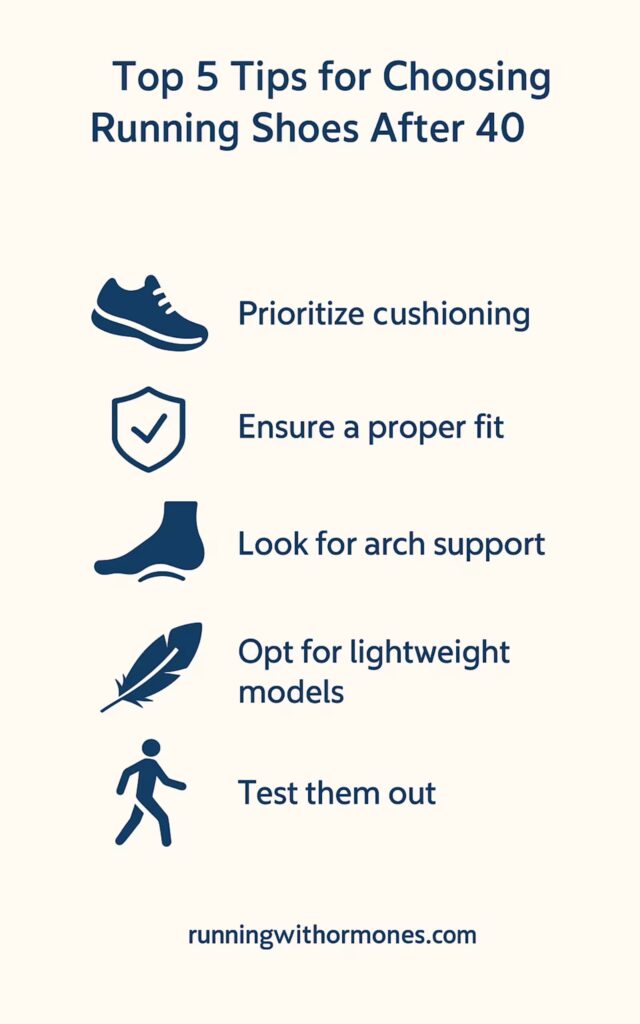
You don’t need a super-cushioned, orthopedic-looking shoe (unless you love that, of course). But you do want a shoe that gives you enough support to protect your joints and enough comfort to make running feel good again.
Look for:
- Reliable cushioning without being too mushy
- Good arch support, especially if your feet are flattening a bit
- Roomy toe box, because feet can spread out more with age
- Secure heel fit, so you don’t feel unstable
- Lightweight design to avoid feeling clunky or heavy on tired legs
And most importantly: they should feel good as soon as you put them on. If they don’t feel comfortable straight out of the box, they probably aren’t the right shoe for you.
Some of the very best running shoes for women over 40 (in my opinion)
Note: I’m not sponsored by any of these brands — these are just solid, well-loved options that work well for women who want comfort, performance, and support.
Here are some of the best running shoes for women over 40 that offer support, comfort, and performance.
1. Brooks Ghost / Glycerin
Brooks has long been a favorite for women runners, and with good reason. The Ghost offers balanced cushioning and works well for neutral runners, while the Glycerin provides a softer ride with more plushness underfoot. Great for long runs or recovery days.
2. Saucony Ride / Triumph
The Ride is light, responsive, and great for daily miles. The Triumph adds more cushioning if you’re looking for comfort on longer runs or tired legs. Saucony’s FORMFIT design also gives a secure fit without being tight.
3. HOKA Clifton / Bondi
If you’re looking for max cushioning without bulk, HOKA is worth trying. The Clifton gives a cloud-like ride in a surprisingly lightweight frame, while the Bondi is ultra-cushioned and great for recovery runs or runners who need joint relief.
4. ASICS Gel-Nimbus / Cumulus
ASICS is known for reliability. The Gel-Nimbus has plush cushioning and shock absorption that makes it a solid choice for aging joints, while the Cumulus offers a slightly firmer, more responsive feel.
5. New Balance Fresh Foam 1080
This shoe has a wide base and a super comfortable ride. Great for women who want a soft feel underfoot with plenty of room in the toe box. It’s especially good if your feet tend to swell during longer runs or in warmer weather.
Final Thoughts
The best running shoes for women over 40 are about listening to your body and choosing what keeps you moving, pain-free, and confident. Your feet, your knees, and your energy all deserve that kind of support.
If possible, try shoes on in person or order from places with a good return policy. Trust how they feel, not just what the label says.
Your body’s changing. That’s normal. And with the right gear, you can keep running strong for years to come.
FAQs: Best Running Shoes for Women Over 40
What are the best running shoes for women over 40 right now?
The best running shoes for women over 40 balance cushioning, support, and fit without feeling bulky. Popular options include Brooks Ghost/Glycerin, Saucony Ride/Triumph, HOKA Clifton/Bondi, ASICS Gel-Nimbus/Cumulus, and New Balance 1080. Try on a few pairs and see how they feel on your foot. Keep in mind width, cushioning feel, and heel security.
Are there running shoes made specifically for older women?
Most brands don’t label shoes by age, but the best running shoes for older women offer width options, stable heels, and cushioning that protects joints while staying lightweight.
Do women over 40 need more cushioning?
Often, yes because fat pads under your foot can thin with age, so moderate cushioning helps with comfort and recovery. Choose a balanced, responsive midsole over ultra-soft “mushy” foam.
What heel-to-toe drop is best after 40?
An 8–12 mm drop works well for many runners over 40, easing calf/Achilles load. If you prefer lower drop, transition gradually to avoid soreness.
Which shoes are best for knee pain in women over 40?
Look for stable neutral shoes with consistent midsole foam and a secure heel (e.g., Brooks Glycerin, HOKA Clifton, ASICS Nimbus). If you overpronate, try light-stability models.
What if my feet have widened or my arches are falling?
Choose brands with wide or extra-wide options and a roomy toe box (New Balance, Brooks, Altra). Add structure via the heel counter and midfoot wrap, not tight forefoot fit.
Are lightweight shoes okay for older women who still want speed?
Yes, light daily trainers can be great if they keep a stable heel and enough cushioning for your mileage. Avoid super-minimal models unless you’ve adapted slowly. Keep in mind, though, that the lightweight shoes generally last shorter. Their cushioning often wears down faster so you may have to buy new ones more often.
How should running shoes fit for women over 40?
Thumb’s width of space at the toes, snug heel with no slip, and secure midfoot. If toenails or bunions are an issue, prioritize width and toe-box height.
Can I use the same shoes for running and walking?
You can, but frequent walkers may prefer a second pair. Rotating pairs extends life and lets foam rebound between sessions.
How often should I replace running shoes after 40?
Every 500–800 km (300–500 miles) for most trainers, sooner if you see outsole wear, new aches, or a “dead” feel.
What’s better for older women: neutral or stability shoes?
Match the shoe to your gait, not your age. Neutral is fine if you don’t overpronate; light stability can help if your arches collapse or your knees track inward.
Do insoles or orthotics help?
If you need extra arch support or pressure relief, try a quality insole. Custom orthotics can help specific issues—test inside a shoe with a removable sockliner and enough volume.
References
Harvard Health Publishing. (2023). Why your feet get bigger as you age. Harvard Health. https://www.health.harvard.edu/pain/why-your-feet-get-bigger-as-you-age
Reeves, N. D., Dixon, S. J., Spink, M. J., Chockalingam, N., & Cronin, N. J. (2023). Age-related differences in women’s foot shape. Journal of Foot and Ankle Research, 16(1), 1–9. https://pubmed.ncbi.nlm.nih.gov/39369693/
UChicago Medicine. (2019). Do our feet change in middle age? https://www.uchicagomedicine.org/forefront/orthopaedics-articles/2019/october/do-our-feet-change-in-middle-age